Pengachu
Overview
Pengachu — "a cheap wireless Linux palmtop for everyone" — was a 2000–2001 MIT Media Lab project to build a pocket-sized, fully open Linux computer years before such a thing was common. Well before the OLPC or the Raspberry Pi, Pengachu aimed at a sub-$50, hackable handheld with peer-to-peer wireless networking, pointed squarely at education and use in "infrastructure-poor places."
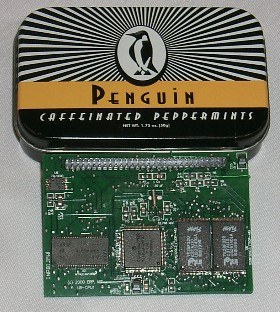
It was built by Wendy Ju, Rehmi Post, and Matt Reynolds — three equal contributors — in a two-month "little skunkworks" crash-development sprint, and shown at the Media Lab's Things That Think consortium meeting. About the size of a tin of mints:
Design goals
Small, cheap, and long battery life
Peer-to-peer ad-hoc wireless TCP/IP networking
Open software (GPL) and open hardware — no license fees
A complete software development environment on board: vi, emacs, C, and Scheme
A reusable module set that other embedded projects could build on
System architecture
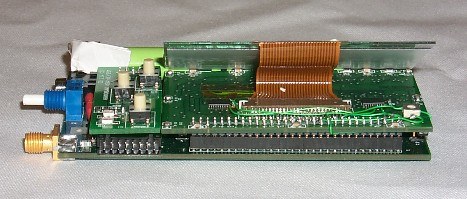
Pengachu was organized as four reusable modules that could be mixed and matched:
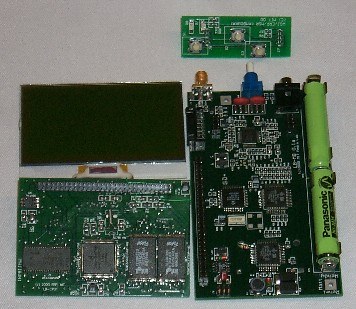
Processor core — a Motorola DragonBall CPU with 8 MB of flash and 8 MB of DRAM, running Linux.
Mothercard — an audio DSP, a 200 kbit/s TDMA/FDMA data radio, the backplane-bus controller, and up to 64 MB of removable flash.
User-interface board — a removable front panel with a 128×64 LCD, buttons, and a scroll wheel.
Docking station — battery charging and wired connectivity.
The boards talked over a deliberately cheap backplane — a 1 Mbps SPI bus rather than anything exotic. Aggressive power management let it decode MP3s on roughly 50 mW, and the entire software stack — web browser, full TCP/IP suite, NFS, a web server, plus the on-board compilers — fit in under 1 MB.
Two flavors
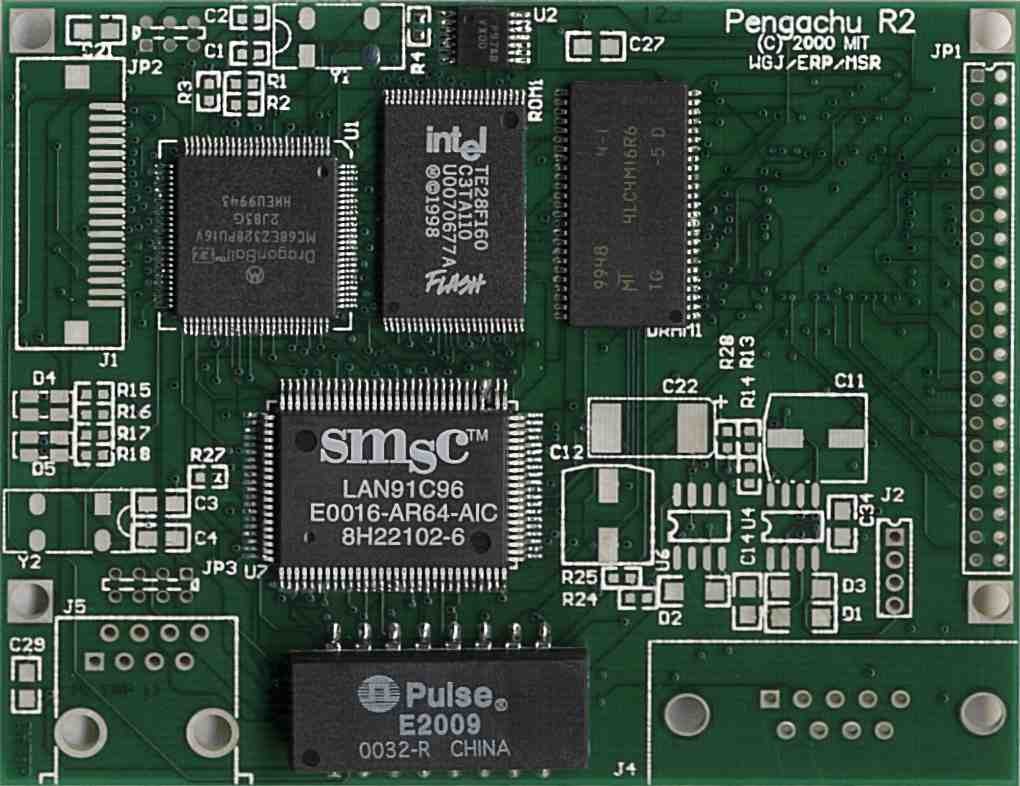
The same core spawned two boards. The Pengachu PDA ran from two AAA NiMH cells, driving a 128×64 (or 320×240) LCD with a PIC16LF877 as its housekeeping controller. The Pengachu Server — the board shown at the top — added 10-BaseT Ethernet, CompactFlash/IDE storage, and, in one variant, a Xilinx 30k-gate FPGA behind a reconfigurable 40-pin user port, so it could serve its own web pages and take on "arbitrarily complicated custom stuff."
Networking
Everything was peer-to-peer and standards-based (TCP/IP). A 900 MHz, 1 mW, 200 kbps radio handled the wireless LAN — either ad-hoc peering or hub-and-spoke gateways to the internet — while a 1 Mbps multidrop RS-485 link covered the wired case (Ethernet was judged too power-hungry, and Cat-5 too expensive, for the target). A device could move between connected and detached modes freely.
Context
Pengachu grew out of the Media Lab's interest in ubiquitous, reconfigurable computing and drew on a library of freely reusable FPGA IP cores that Rehmi maintained. Its mix of open hardware, open software, cheap wireless networking, and an education-first mission reads today like a preview of the low-cost-computing-for-everyone projects that arrived years later.
Project Pengachu — Wendy Ju, Rehmi Post, and Matt Reynolds. MIT Media Lab, 2000–2001.